In insurance and financial services, the problem is rarely a shortage of information. The problem is finding the right information, understanding its context and acting on it quickly.
Important knowledge is distributed across policies, underwriting manuals, regulatory publications, claims files, contracts, risk reports and operational procedures. Conventional search can locate documents containing specific words, but it cannot reliably explain how different passages relate to a business question.
The application is designed to close that gap. It transforms controlled collections of documents into an evidence-led workspace where users can ask questions in natural language, analyse requirements and inspect the sources behind every answer.
Rather than behaving like a general-purpose chatbot, the application applies generative AI to an organisation’s own authorised content.
The central idea is simple: move from “find me a document” to “help me understand the evidence contained across these documents.”
From document search to document intelligence
A traditional search engine returns files or passages. The application assembles relevant evidence into a usable response while preserving the connection to the original material.

This approach is known as retrieval-augmented generation, or RAG. In plain language, RAG gives an AI model a controlled research step: before answering, it retrieves relevant material from the organisation’s document library and uses that material as its context.
This is an important distinction. The application is not intended to replace a policy owner, underwriter, compliance specialist or legal reviewer. It helps those people find, compare and interpret evidence faster.
What the application provides
The application organises work into projects and libraries. Teams can upload document collections, control access, collaborate and interrogate the material through several complementary experiences.
| Capability | What the user experiences | Business purpose |
|---|---|---|
| Natural-language enquiry | Ask a question as if speaking to a knowledgeable colleague | Reduces dependence on exact keywords and document familiarity |
| Evidence-backed answers | Responses include citations, page references and source excerpts | Makes answers reviewable rather than opaque |
| Document libraries | Content is grouped into controlled knowledge collections | Supports separation by client, case, product or confidentiality level |
| Project workspaces | Documents, users, conversations and analysis are brought together | Keeps intelligence connected to a specific business context |
| Requirements analysis | Obligations and requirements can be extracted and linked to evidence | Accelerates structured review of complex documents |
| Coverage and gap assessment | Requirements can be assessed against supporting project evidence | Highlights what is covered, missing or requires expert review |
| Preset analysis | Reusable analytical views surface themes, risks and key findings | Introduces consistency across recurring reviews |
| Shared conversations | Teams can retain and share useful lines of enquiry | Reduces duplicated research and improves knowledge transfer |
| Administration and audit | Roles, activity and operational status are centrally managed | Supports accountability and controlled adoption |
The result is not simply a faster search box. It is a workspace for turning unstructured documents into traceable decisions.
Where the value comes from
The business value of document intelligence appears across four connected areas.

Faster access to the relevant evidence
Complex document reviews often require specialists to open multiple files, search for terminology, inspect surrounding pages and manually reconcile findings. The application compresses that discovery process by retrieving potentially relevant material across the authorised document set.
This does not eliminate expert review. It allows expert time to be directed toward interpretation, exceptions and judgement rather than document navigation.
Better consistency
Manual reviews vary according to the reviewer’s experience, available time and familiarity with the source material. Reusable analysis patterns can help teams ask the same core questions across each submission, policy, claim or control assessment.
Consistency is particularly valuable where an organisation needs to demonstrate that defined checks were performed, even when different people performed them.
Greater transparency than an isolated AI assistant
A confident answer without evidence is a liability in a regulated environment. The application is designed around sources: retrieved passages retain document, page and library identity, and users can return to the underlying material.
Citations do not make an AI response automatically correct. They make it possible to inspect how the response was formed—and to challenge it when the evidence does not support the conclusion.
Institutional knowledge that survives the individual task
Useful questions, findings and document collections can be retained within the project rather than disappearing into personal notes or email threads. Over time, this creates a reusable layer of organisational knowledge around the original records.
Relevance to insurance and financial services
The application originated as a project-document intelligence platform, but its underlying model maps naturally to other document-intensive, regulated industries.
| Business area | Example document set | Questions the platform could support |
|---|---|---|
| Underwriting | Submissions, schedules, surveys, wording and underwriting guidance | ”Which declared risks fall outside the standard appetite?” |
| Claims | Policy wording, endorsements, correspondence and expert reports | ”Which clauses are relevant to the reported cause of loss?” |
| Compliance | Regulations, policies, controls and evidence packs | ”Which control documents support this requirement, and where are the gaps?” |
| Operations | Procedures, service agreements and process manuals | ”What is the escalation path and which exceptions apply?” |
| Product governance | Product specifications, approvals and distribution policies | ”What customer segment and exclusions were approved for this product?” |
| Third-party risk | Due-diligence responses, contracts, assessments and remediation plans | ”Which material findings remain unresolved?” |
| Lending and investment | Credit papers, covenants, reports and committee records | ”What obligations are triggered if this threshold is breached?” |
| Regulatory change | Current rules, amendments and internal policies | ”Which internal procedures may be affected by this change?” |
These are decision-support scenarios, not autonomous decision-making. High-impact outcomes—such as denying a claim, changing a risk rating or determining regulatory compliance—should remain subject to authorised human review.
How the platform works
The application uses a modern cloud architecture designed to separate the user experience, document processing and AI retrieval workloads.

1. Ingestion
Documents are uploaded to secure object storage. A queue then sends each document to an asynchronous processing worker.
“Asynchronous” means the user does not have to keep a browser session open while a large document is analysed. The processing workload can also scale separately from the interactive application.
2. Extraction and structuring
An OCR and layout-extraction service extracts text, page layout and tables from PDFs. The processing pipeline also identifies figures and retains their relationship with the source document.
The extracted content is divided into meaningful passages. This is called semantic chunking: the system attempts to preserve coherent sections rather than cutting text at arbitrary character counts.
3. Embeddings and vector search
Each passage is converted into an embedding—a numeric representation of its meaning. Embeddings allow the system to retrieve passages that are conceptually related to a question even if they use different terminology.
The vectors are stored in a PostgreSQL database using the pgvector extension. To a non-technical reader, this is a managed database capable of searching content by meaning as well as by conventional metadata.
4. Retrieval and ranking
A business question may contain several separate concepts. The application can decompose the question into focused searches, retrieve evidence and remove duplicate results.
The platform also supports retrieval techniques including:
- Semantic search for meaning.
- Full-text search for exact terminology.
- Citation-aware lookup for named clauses or sections.
- Table-row search for numerical and structured evidence.
- Reciprocal rank fusion, which combines results from different search methods.
- Reranking, which gives the strongest evidence a final relevance check.
These mechanisms improve the material given to the language model. This is critical because answer quality depends heavily on evidence quality.
5. Grounded response generation
The selected evidence is passed to a managed language model. The model composes a response using the retrieved context and returns structured source information.
Stable source identifiers, document identities and page metadata help the interface connect the answer back to the correct source—even where different documents have similar filenames.
Security and governance by design
For financial services and insurance leaders, the question is not only whether AI can produce useful results. It is whether the system can be governed.
The platform includes several controls intended to support an enterprise environment:
| Control area | Approach |
|---|---|
| Identity | Managed identity service with multi-factor authentication support |
| Platform roles | Separate global administrator, application administrator, manager and user roles |
| Project roles | Owner, member and viewer permissions remain separate from platform authority |
| Information boundaries | Access is assigned at project and document-library level |
| Retrieval isolation | PostgreSQL row-level security restricts vector retrieval to authorised libraries |
| Administrative safety | Safeguards prevent removal of the last accountable owner or global administrator |
| Auditability | Privileged actions are written to a filterable activity trail |
| Data lifecycle | Documents, accounts and project relationships have controlled deletion behaviour |
| Operational resilience | Queues, dead-letter handling, backups, monitoring and deployment runbooks support recovery |
These controls are important foundations, but they should not be mistaken for an automatic statement of regulatory compliance. Production adoption in a regulated organisation would still require its own data protection assessment, model-risk review, retention policy, security testing and control mapping.
Trust must be engineered, not assumed
Generative AI introduces risks that conventional applications do not present in the same way. A model can misinterpret a passage, omit an exception or produce a plausible statement unsupported by the source.
The application addresses this by treating evidence as a first-class product feature.
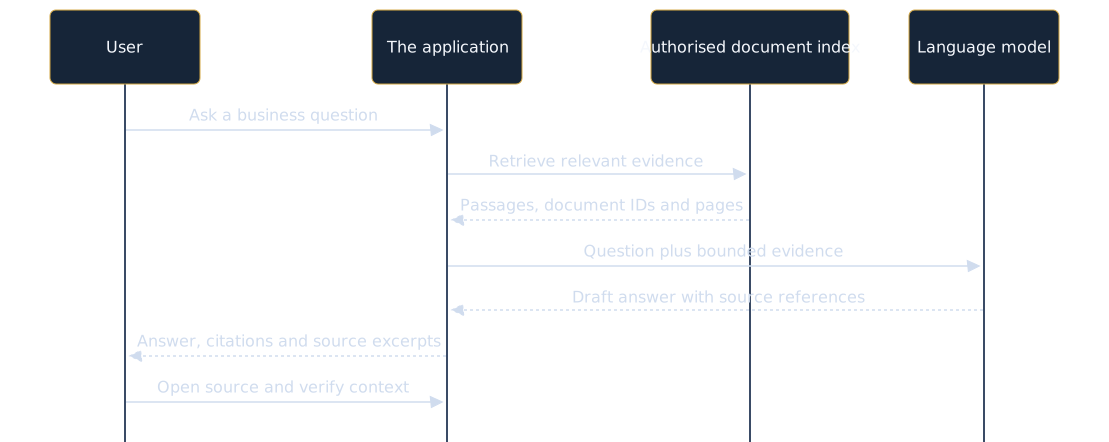
A sensible operating model therefore distinguishes between three levels of use:
| Use level | Appropriate role for AI | Human responsibility |
|---|---|---|
| Discovery | Locate relevant documents and passages | Confirm that the material is applicable |
| Analysis | Summarise, compare and identify possible gaps | Review reasoning, exceptions and completeness |
| Decision support | Prepare evidence for an authorised decision | Retain accountability for the final decision |
This boundary is particularly important for claims, underwriting, credit, compliance and customer-outcome decisions.
A platform rather than a single use case
The strongest long-term value of the application is its reusable architecture.
The same ingestion, access-control, retrieval and evidence mechanisms can support multiple workflows without building an isolated AI solution for each department. A claims knowledge library, an underwriting workspace and a compliance-assurance project may use different documents and prompts, but they share the same foundations.
That creates a potential progression:

Each step moves the organisation from information retrieval toward structured intelligence. The value increases, but so does the need for evaluation, domain ownership and governance.
Measuring success
Success should be measured in operational and trust terms—not by the novelty of the AI interface.
| Dimension | Example measure |
|---|---|
| Efficiency | Time required to locate and assemble relevant evidence |
| Adoption | Active users and repeat usage by business workflow |
| Quality | Retrieval relevance and answer acceptance by domain experts |
| Trust | Citation accuracy and successful source verification |
| Coverage | Percentage of target documents processed successfully |
| Consistency | Variation between reviewers performing the same assessment |
| Risk | Rate of unsupported claims, missed qualifications or access-control failures |
| Value | Specialist hours redirected from document navigation to expert judgement |
A controlled pilot should establish a baseline for the existing manual process and compare it with AI-assisted work. This provides a more defensible business case than estimating savings from document volume alone.
The larger opportunity
Enterprise AI becomes valuable when it is connected to trusted information, embedded in a real workflow and operated within clear boundaries.
The application demonstrates that pattern. It combines the accessibility of conversational AI with document processing, semantic retrieval, collaboration, source inspection and enterprise access controls.
For insurance and financial-services organisations, the opportunity is significant: large document estates can become active sources of operational intelligence rather than passive archives.
The enduring proposition is not that AI should make high-impact decisions on behalf of the organisation. It is that people responsible for those decisions should be able to reach the right evidence faster, see where it came from and apply their judgement with greater confidence.